I can’t say exactly when I was old enough to have “real” conversations with my parents, but for as long as I can remember my mom and I have talked about everything from science to linguistics to politics and sociology. In these discussions, she always encouraged me to become an “educated person”—this was her ideal citizen. As an archaeologist in New Mexico, she wrote her thesis on the roads of Chaco Canyon; when she saw vb price listed in UNM’s University Honors Program catalog, she told me that his poems about Chaco give her goosebumps every time. The next day I signed up for his course “Orpheus the Healer” because I thought it would be fun to spend a semester reading poetry with a respected poet. In the years since then, I have learned more about myself and my world from this teacher—no, mentor—who epitomizes the “educated person.”
The first night of class, he asked that we not call him “Mr. Price” (that would be his father) and instead introduced himself as Barrett, with “two ‘Rs’ and two ‘Ts.’” Then in his sixties, he looked a little like Santa in blue jeans and a sports coat; I later learned that Santa is one of his heroes because he offers unconditional acceptance. Perhaps it is not surprising, then, that Barrett’s classroom is one of unconditional acceptance—students work hard not out of fear but rather out of respect and a desire to please. Although “Orpheus the Healer” was not a writing class, it required a significant amount of writing, in journals, a shorter paper, and a longer paper. Having spent his entire adult life as a journalist, columnist, poet, novelist, and editor, Barrett had some ingenious tricks to help prepare us for these papers—as it turned out, his tricks also helped us to think like “educated people.” We met once a week, on Thursday evenings. To prepare for class, it was necessary to read dozens, if not hundreds, of poems per week and to keep a journal. The poems were all were somehow related to the “Orpheus” myth, from Homer and Sappho to E.E. Cummings, Allen Ginsberg, and countless others. Barrett also announced 10-15 questions to contemplate in our journals in light of the upcoming poems for the next meeting. Additionally, we were encouraged to write down any other ideas we might have linking these poems to our own lives and to our own world. These journals—though private and never collected—provided the basis both for class discussion and for our papers. He trusted us to do the work, and we rarely let him down.
My students may already notice some similarities between my classroom and my mentor’s.
On a typical Thursday evening, students would start arriving around 5:00 or 5:30 for a 6:00 class, and we’d sit around talking in the lobby until Barrett’s arrival, when we’d move to the seminar room and chat some more. Promptly at six, he’d close the door and class would begin. He would usually talk for fifteen or twenty minutes about any number of things that might help make the poems relevant to our own world, from recent news stories to quotations from books he’d read. Then, he would set up the next week’s readings with some biographical information about the poet, perhaps a personal experience he’d had with a particular poem, and then he would announce the journal questions. To this day, I cherish what happened next: we each had an opportunity to share our thoughts with the class. Everybody was expected to speak at least once per evening, and although such personal discussion could easily turn political, we always maintained a high level of respect for one another. This way, we were able to work our way through most of the poems and understand each other a little bit better. Very often, a poem that was unremarkable to one person would “speak” to somebody else. Understanding the ways a poem (perhaps even one you had previously “hated”) had helped a classmate to cope with a parent’s suicide, for instance, led all of us to see each other not only as being both more fragile and yet similarly more like ourselves than we might have previously thought; over the course of the semester, moreover, it became clear that people basically haven’t changed in thousands of years. While the discovery that our own personal struggles are not unique is, not, I think, in and of itself, comforting, in giving us new perspectives and old through poetry and philosophy as springboards for self inquiry, Barrett helped us to make better sense of a wild and random universe. By encouraging such examination of the self and of the world, Barrett helped us to cultivate a sense of empathy and social responsibility grounded in literature and tradition. Around 7:30, we would take a break, although conversation about poems and life usually continued anyway. After the break, one student would give a presentation on a poet or an influential philosopher. By reading many of the “greatest hits” of world poetry, thinking about them the way other poets might, and writing about them as belletrists of earlier generations might, Barrett mentored all of us to become “educated people.”
I wish I had the guts to use class time the way Barrett does. But I also know the importance of a rigorous education, and there is no substitute for learning basic concepts. This is why I don’t devote much class time to discussing personal reactions to literature. Instead, I focus on literary and historical concepts that students will need as they move forward in their education and in their lives. But I can’t simply prepare them for upper-level courses (such as Barrett’s), which is why I, too, ask my students to keep a reading journal. I have even sometimes recycled some of Barrett’s questions on my own students!
Because Barrett writes day in and day out for a living, he has high expectations of his students’ writing. The first paper he assigned was open topic, so long as it related to class. As he put it, we were free to write on any topic…except for electric trains. I translated one of Rilke poems about a rose, talked about the problems of translation, and then I wrote on roses in my life. A year later, I wrote on toy trains. At one point, he announced that our paper should be about 750 words before changing his mind and demanding that it be exactly 750 words. We were all up for the challenge, and I wrote on the idea of “winners” and “losers” as presented in literature compared with societal values. I remember putting hours and hours of thought into my papers, but I was never afraid to turn one in. Rather than assigning a grade, he would mark it up (with arrows and underlining, just like in his own books he’d photocopied for handouts) and respond in a one-page letter. He was more interested in the things we got right and the ways we were learning than the places he could take off points. I will treasure those letters for many years to come. And for my last paper, I wrote him a letter that tied together many years of guided thought. The subject was decadence, and I cited texts we had read in various classes as well as books he had mentioned in passing in class as having influenced his patterns of thought.
I can see now that Barrett was providing us with an environment where we could be ourselves—and find out what that entails. In other words, he was showing us how to become “experts” on our own on any subject, and he was more interested in helping us to become “educated people” than in boosting his own ego. As I think about Barrett’s question, are you the nag that never lets yourself stop and rest or the mentor who lets yourself go at your own pace?, I realize that he was a mentor above all else. Distinct from our continuing relationship after graduation, I suppose the most influential element of Barrett’s classroom was his role as mentor rather than nag. And, as he has often remarked, writers practice their craft not for perfection, but rather to be prepared for a time when something important must be written with only a few moments’ notice. A mentor knows that the purpose of education is not to master a set of knowledge or particular skills, but rather to cultivate life-long habits that continue long after the final exam. Now that it is my turn to be the teacher, I always remind myself to be a mentor rather than a nag.
At the most basic level, my role as a mentor calls for the “unconditional acceptance” Barrett associates with Santa Claus. One of his questions, who is the first person who treated you as a human being above anything else?, reminds me that my students are not just another paper to grade. To offer them the compassion and patience they deserve without making myself vulnerable to chronic sidetracking and needless paper extensions requires me to outline my expectations early on and, paradoxically, to maintain simultaneous rigidity and flexibility. Barrett expected us to have read many pages of poems and to have written several pages of response in our journals; my syllabus and assignments will send the message of rigidity, while my grading and classroom discussion will be appropriately more flexible. Again, I see myself as a mentor—as someone who is still learning the craft but with more experience that I’m willing to share—and this relationship is reflected in the rigor of the syllabus and in my approach to grading.
On his syllabus, Barrett calls grading a “necessary evil,” a phrase I have borrowed for my own. I will never forget the thrill of getting a paper back marked up like our handouts. Instead of dwelling on the mechanical errors and untenable arguments, Barrett focused on the things his students got right and praises risks they may have taken, even if the idea did not ultimately pan out. While I’m optimistic that I’ll have a classroom of Hemingways, I recognize that as a mentor, it will be my job to point out some errors, too, while offering suggestions for improvement. If a “nag” might be somebody who marks every comma splice, scribbles “interesting” next to arbitrary passages, and declares at the end, b+: good paper, a mentor might be somebody who marks some comma splices, suggests further reading next to specific passages, and declares at the end, b+: your grammar is improving but you’re not quite there yet; keep up the good work. Moreover, my students have many (ungraded) opportunities leading up to the (graded) essay. In both cases, I am their advocate. Above all, as a mentor rather than a nag, I approach each paper not looking for places to take off points but rather for places to give points.
As I think back on my time with Barrett and with other mentors such as violin teachers, I realize that the lessons I learned in those encounters were relevant to many areas of my life and ways of thinking. So while I may not be able to insist that my students reconsider the whole of their world-view, as a mentor I owe it to them to give them the tools to rethink their world. Now that it’s my turn, the best chance I have to help my students become “educated people” is to follow Barrett’s example and provide a model of one for my own students.
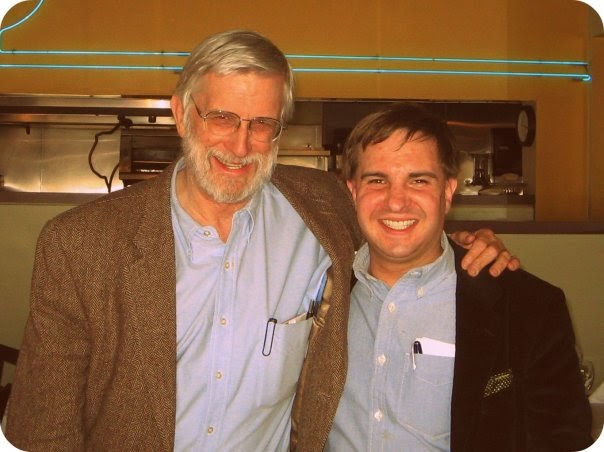
Postscript by VB Price
My mentor Katherine Simons used to say “good students make good teachers.” Katherine taught Shakespeare at the University of New Mexico from before World War II into the early 1980s. She was one of the founders of the UNM General Honors Program. She thought of herself as a “teaching scholar.” All her extensive research and travel was poured into her lectures and seminars, not into academic prose. Katherine remains the “best” teacher I’ve ever known. And hundreds of her other students thought so too. Katherine didn’t have a bone of narcissism in her. She paid attention to her students. My relationship with Katherine went from my first class with her until the end of her life, nearly thirty five years later. Early on, she chose to overlook my appalling writing skills and focus on what she considered to be a mind worth cultivating, to my vast surprise and endless gratitude. Her confidence in me woke me up; she saw something in me that I hadn’t seen. And she led me to think that I was worth my own best efforts as a student, and a writer. What a gift! Later, we met serving on a museum board together and she allowed as how I could call her Katherine now, not Miss Simons. I was stunned that Katherine Simons and I might become friends. We had many lunches together. We talked for hours about politics and literature. We came to appreciate our differences. She copy edited a magazine I edited called Century, everything in it, for three years. I was asked to give her eulogy. I remember starting it off by saying something like “How can one describe the wonderful life of Katherine Simons?” Then I told the jokes she loved to reel out about her tombstone, which she wanted to read, variously, she always graded her own papers or she never voted for nixon. It was Katherine who made the opening for me to teach in the UNM honors program 22 years ago. I’d just left a job as the editor of New Mexico Magazine. The director of the Honors Program, Charlie Biebel, called Katherine two days before the fall semester of 1986 began, to ask her if she knew anyone who could teach an Ancient Legacy course on short notice. She said that I’d just given her a poem on Virgil and she was fairly sure I’d love the chance to teach. Two days later, I started what would become one of the happiest periods of my life. Without Katherine I’d never have had the joy of meeting Richard Obenauf, a friend and inspiration indeed. The more I get to know Richard, the more I know Katherine was right about good students making good teachers. But the more I think about what Katherine gave to me early on, the more I understand that not-so-good students make good teachers too, if you see your job as helping students believe they are worth their own best efforts.
 Richard Obenauf, PhD